


Fire crews and planes are wrestling to bring a huge wildfire under control in south-west France before a forecast jump in temperatures complicates the massive firefighting effort against a blaze that has burned an area four times the size of Paris.
Interior minister Laurent Nunez said the fire had stopped growing, a first glimmer of hope since the inferno forced 220,000 people to flee in the region around the city of Bordeaux.
But with woodlands still smouldering, the minister cautioned that the battle is not yet won.

“It hasn’t progressed during the night,” Mr Nunez said.
“We have to remain very concentrated, very determined, to go at any moment.”
He spoke after French President Emmanuel Macron held a crisis meeting focused on the blaze in the Gironde region and wildfires that fire crews continue to tackle elsewhere.
The Gironde prefecture said the situation overnight remained “globally stable” – a change from previous days when officials said flames had crept to within 15 kilometres (10 miles) of the outskirts of Bordeaux, a historic city of 268,000 people, and generated self-feeding firestorms with lightning bolts that ignited more blazes.
No new evacuations were announced on Monday.
But with France about to enter its peak August tourist season, Gironde authorities worked to keep tourists away, banning holiday camps for children and for people with disabilities.
Mr Nunez also urged people to avoid the region, popular for its Atlantic beaches and some of France’s largest woodlands.
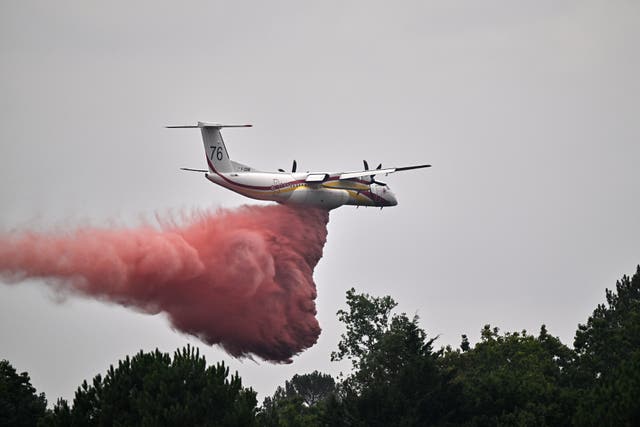
In the adjacent south-western Landes region, where hundreds of firefighters have been making progress against another virulent but smaller fire, the prefecture said some rain fell overnight and described the conditions as “favourable” for firefighting but also cautioned that they could change.
With thousands of firefighters on the ground and rotations of water- and retardant-dropping aircraft in the air, it became a race against time before a forecast surge in temperatures from Tuesday that could make fighting flames more difficult.
“We know temperatures are going to climb again, that we’ll enter a phase of intense heat and so we really have to remain very cautious,” Mr Nunez said.
“As long as the fire isn’t contained, the situation remains unfavourable.”
Crews using earth movers tore up strips of forest and scrubland to create barren spaces, intended to stop fires from spreading.
Farmers were keeping fire crews supplied with water, transporting it to them in tanks.
Around a dozen countries have provided planes, helicopters, firefighters and other assistance to both France and Spain, which is also fighting unprecedented blazes.
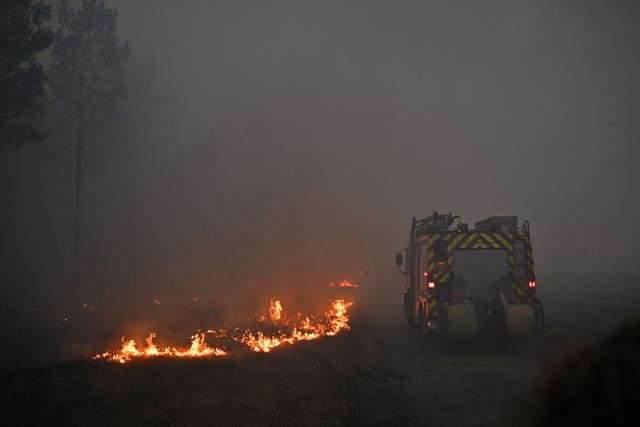
All told, fires in both countries have forced more than 330,000 people to flee.
Mr Macron did not immediately comment after the government crisis meeting he presided over.
In a weekend post on X, he pledged long-term support for fire-hit communities, saying: “We will rebuild, we will repair and we will be present for as long as necessary.”
In Spain, wildfires have burned out of control around Madrid and in the Valencia region.
Authorities evacuated 76,000 people and confined 30,000 others to their homes.
In both Spain and France, the exceptional scale of the fires – fuelled by heatwaves that hit especially hard and early this year, making forests and scrubland tinder-dry – are driving calls for stronger action against climate change.
“What we are experiencing is not a series of isolated incidents. It is the consequence of a climate emergency that is making wildfires even more violent, heatwaves more frequent,” Spanish Prime Minister Pedro Sanchez said.

A fire raging in hilly, rural terrain in Avila, west of Madrid, has become Spain’s largest on record, scorching 50,000 hectares (193 square miles), the government says.
All told, fires have burned 153,000 hectares (590 square miles) this year in Spain – six times the area scorched by blazes in the first half of 2025, said Sara Aagesen, the ecology minister.
The minister said that another heatwave forecast from Tuesday – which would be Spain’s fourth so far this year – could ratchet up the fire danger.
Evacuees are fretting about what they will find when they are allowed to return to fire-hit regions.
“It looked like the apocalypse. You couldn’t see anything. Everything was covered in ash,” said Rocio Dominguez, who evacuated with her dog, Simba, from Chapineria, west of Madrid.
“We don’t know when we get to the town, if we’ll have half the house burned down or we’ll have it intact or we won’t have a house,” she said.

“All the clothes, all the memories, everything.”
A wildfire driven by strong winds broke out on Sunday afternoon near Peschici, in Italy’s southern Puglia region, burning pine forest and scrub and forcing the evacuation of about 300 tourists from beaches and campgrounds, authorities said.
The Coast Guard evacuated tourists by sea to nearby Vieste, where authorities opened temporary shelters.
Three Canadair water-bombing planes and fire crews on the ground continued on Monday to battle the blaze, which revived memories of devastating wildfires that hit the same coastal area in 2007.